Most people who hold this title never applied for it, and most organizations that depend on it have never written it down. That is why the role feels fuzzy from the inside: you are doing the work, and nobody has told you what the work is. This page describes the job, drawn from Chapter 1 of Strategic Web Management, so you can measure yourself against the actual role rather than against a developer, a designer, or the person who left.
Download the Role Blueprint (PDF)Why the job has no description
Digital responsibilities accumulate in organizations one good decision at a time. A domain gets registered for a launch. Someone opens an email marketing account during a campaign. An intern creates the social profiles. A contractor builds the website and hands over a login that is forwarded twice and then forgotten. Ten years later the organization rents a dozen digital properties with no landlord of record, and when the one person who understood most of it leaves, the pile flows downhill to whoever is nearest and most capable.
There is a structural reason it lands this way. In a small organization, web management touches marketing, information technology (IT), legal, and operations at once, which means it belongs cleanly to none of them and appears in nobody's job description. The work is real but rarely full-time, so leadership reasonably concludes that someone on staff can absorb it. The someone is usually the person who fixed the printer, built the mail merge, or answered the last "is the website down?" question.
If that is you, the fuzziness is not a sign you are unqualified. It is a sign the role was never defined. The rest of this page defines it.
The definition, and the word that matters
A web manager is the person responsible for the strategic and operational oversight of an organization's entire digital presence. The word doing the work in that sentence is entire. Your digital presence is everything the organization owns or rents online: the website, but also the domain names, the hosting account, the business email, the social profiles, the analytics, the web app subscriptions, and the payment tools wired into all of it. Together this collection is the web stack, and the stack, not the site, is what a web manager manages.
Most accidental web managers discover the true size of their stack only when something in a forgotten corner of it breaks. A web manager's first job, before any improvement, is knowing what is in the portfolio.
The real job: three duties
Stated plainly, the work settles into three duties, and nearly everything a web manager does serves one of them.
Risk reduction. The domain renews. The backups exist and have been restored at least once. The passwords belong to the organization rather than to a departed employee. The site does not invite legal trouble over privacy or accessibility.
Continuity. Everything keeps working through staff changes, vendor changes, and your own vacation. In practice this means documentation someone else could follow without calling you: an inventory of accounts, a record of who can log in, and a short runbook for the things that go wrong.
Steady improvement. The digital presence serves the mission a little better each quarter: clearer content, faster pages, a form that converts, and an honest answer to the question "is any of this working?"
Risk comes first in that list on purpose. An organization with a beautiful new website and an expired domain has nothing; an organization with a plain website, a current inventory, and a tested backup has a managed asset. Improvement is the reward for getting the first two duties under control.
What the rhythm looks like
When the role is healthy, it is a rhythm rather than a grind. A typical week includes approving a content update, glancing at an uptime report, and answering one access request. A typical month adds a look at the analytics summary, confirmation that backups ran and one restore was tested, and a vendor invoice paid or questioned. A typical year includes domain renewals, a budget conversation, a security review, and one improvement project chosen deliberately rather than forced by an emergency. The role is measured in quiet quarters and small, visible improvements.
What is not the job
Writing code is not the job. Designing graphics is not the job. Running the office network and fixing laptops is not the job, even though the "good with technology" reputation will attract those requests. These are crafts you can rent by the hour from freelancers, agencies, and platforms, and renting them is usually the right call. A web manager benefits from understanding how each craft works; performing it personally is optional.
Confusing the two is the most common reason capable people believe they are unqualified for a role they are already doing. It is also the most common way the role quietly doubles in size. When a colleague brings a printer jam, the recommendation is a warm redirect rather than a quiet yes: "That one is outside what I cover; I handle our web presence. Here is who to call." Should leadership decide the roles ought to combine, that is a legitimate decision, but it should be made explicitly, with the added scope named and the added time budgeted.
A useful way to hold all of this is to think like a property manager rather than a builder. A property manager does not pour foundations or rewire buildings. A property manager knows what the portfolio contains, when every lease renews, which contractors to call, where the insurance sits, and which building needs attention next. Your domains, accounts, subscriptions, and vendor relationships are exactly that kind of portfolio.
Where the web manager fits among other roles
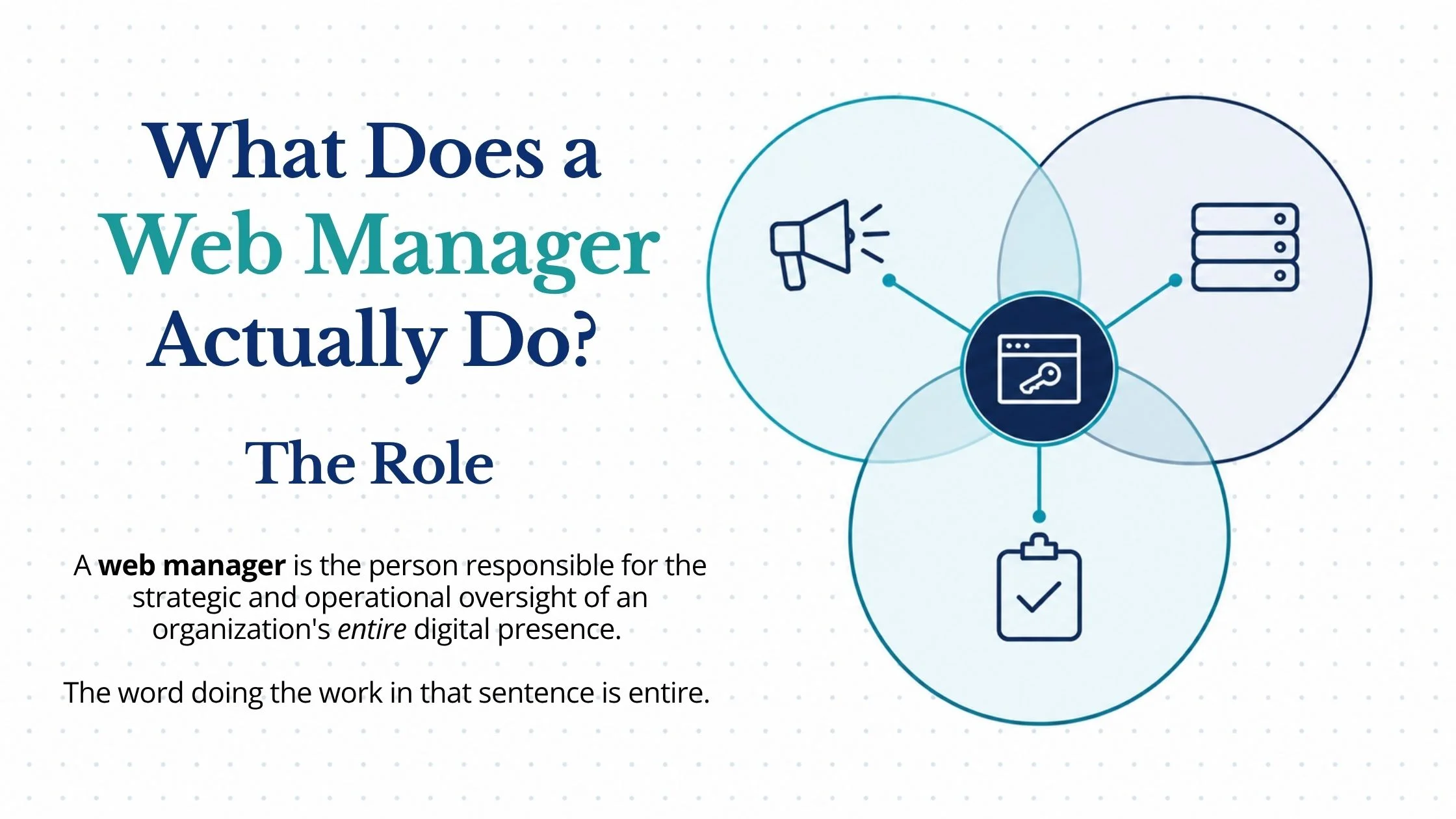
Picture three overlapping circles labeled marketing, IT, and operations (which, in a small organization, includes legal and finance). Marketing owns the message. IT owns the network and the devices. Operations owns the budget, the contracts, and the policies. The website, the domain, the email, and the subscriptions sit in the space where all three circles overlap, and that overlap is where the web manager stands. The role does not replace any of the three; it is the one seat with a view of all of them.
The table below separates the web manager from the roles it is most often confused with.
Role | What they do | How the web manager works with them |
|---|---|---|
Web developer | Builds and codes the site, fixes bugs, integrates systems | Writes the scope, owns the accounts and files, evaluates the result; does not write the code |
Web designer | Creates the look, layout, and brand visuals | Sets the site's job and brand decisions, approves the design, keeps the brand kit |
IT support | Runs the network, devices, and internal systems | Coordinates on email, security, and access; refers laptop and printer requests back to IT |
Webmaster | The older title for one person who did everything, from server to copy | Today the work is split across vendors and platforms; the web manager coordinates it rather than performing it |
Marketing coordinator | Produces campaigns, content, and social posts | Shares the content calendar and analytics; the web manager holds the platforms, accounts, and renewals the campaigns run on |
If your business card says webmaster, marketing coordinator, office manager, or executive director and you recognized yourself in the right-hand column, you are the web manager, whatever the title.
How the work gets done: decide, delegate, automate
Given all of the above, the defining question of the role is not "can I learn to do all of this?" It is "how should each of these get done, and by whom?" Your value to the organization is judgment, not keystrokes. The web managers who burn out are almost always the ones who tried to personally perform every task in the stack; the ones who thrive treat the role as a series of decisions, and a three-part framework keeps the decisions sorted.
Decide covers the judgments only you, or you plus leadership, can make: what the organization owns and under whose name, what the budget is, how much risk is acceptable, what the website is for, and which voice and brand it presents. A vendor who offers to make these for you is overstepping.
Delegate covers skilled work others perform better and faster: code, design, copywriting at volume, specialized security response. Delegation done well requires a written scope and a vendor you can evaluate.
Automate covers the repeatable and forgettable: renewal reminders, backups, uptime monitoring, report generation. Machines are more reliable than memory for all of it, with one caution: automation is not abdication. A backup that has never been test-restored is a hope, not a plan. Keep a short log of what you have automated and confirm it monthly.
The skills that matter (none of them is coding)
The skills that caused the role to find you are the actual qualifications. Organization, because the job begins with an inventory and lives on documentation. Communication, because most of the work is asking vendors plain questions and translating the answers for leadership. Follow-through, because renewals, restores, and reviews happen on a calendar or not at all. A willingness to read the instructions, because every platform you rent has documented the thing you need, and most people never look.
Two more grow on the job. Comfort with a report: you do not need to build analytics, but you should be able to read a one-page summary and say whether this quarter was better than last. Prioritization: the inventory will surface more than you can fix, and the job is choosing what to fix first, which is why risk sits ahead of improvement. Technical knowledge can be acquired chapter by chapter. Conscientiousness cannot be taught nearly as easily, and you evidently already have it.
Signs you are doing the job well
The role rarely produces applause; it produces the absence of emergencies. These are the markers worth checking against.
A dated, one-page inventory of every domain, host, platform, and paid service exists, and a second person knows where it is.
At least two people can log in to the registrar, the host, and the website.
No renewal has arrived as a surprise this year, and none sits on a departed employee's card.
A backup has been restored, on purpose, in the last quarter.
Leadership receives a one-page monthly report and has started asking you before buying a new tool.
The last improvement project was chosen from a plan, not from a Friday-afternoon outage.
Vendors answer to a written scope, and you could replace any one of them with the files and accounts you already hold.
Three or fewer is normal in the first year. The list is a destination, and the book is the route.
The seventeen areas the role covers
Strategic Web Management maps the role onto seventeen areas, one per chapter: web account inventory and documentation; domains and the domain name system (DNS); hosting, certificates, and backups; platforms and the content management system (CMS); design, user experience, and accessibility; content strategy and maintenance; website security; performance, search engine optimization (SEO), and generative engine optimization (GEO); business email; email marketing; social media; analytics and reporting; digital assets; vendors and budgets; artificial intelligence (AI) tools; legal, privacy, and compliance; and the 90-day and annual web plan.
No one is responsible for all seventeen at the same depth, and no one needs to be. The Web Manager Self-Assessment Scorecard in Chapter 1 has you rate your confidence in each area, mark which ones you actually own, and flag every area where responsibility is high and confidence is low. Those flags are your reading order, and they become the seed of your 90-day plan.
The role in three sentences
A web manager is the steward of an organization's entire digital presence, not just its website. The job is reducing risk, keeping everything running through change, and improving the presence deliberately, in that order. It is a management role, done through decisions, documentation, and vendors, and it has never required writing code.
Get the Web Manager Role Blueprint
The Web Manager Role Blueprint puts this page on paper: the three duties with their weekly, monthly, and annual rhythm; the "not the job" boundary with the warm-redirect script; the role comparison table; the core skills; the signs-of-health checklist; and the seventeen-area scorecard to find your gaps. It is free with a Web Managers Portal account, which also includes the free First-Aid Kit.
DOWNLOAD THE ROLE BLUEPRINTTurn the blueprint into a plan
Knowing the role is the first step. The companion course, Strategic Web Management: From Accidental to Strategist, turns this blueprint into a 90-day action plan: the inventory in weeks one and two, the risk fixes in order, the monthly report to leadership, and the annual web plan that ends the firefighting. Every lesson comes with the activity guide and rebrandable template from the book.
Start with the BookAbout Bryan
Who wrote this
Bryan C. Mills has spent twenty years managing web infrastructure and helping churches, nonprofits, and small organizations take control of their websites. He is the author of Strategic Web Management, the host of The Web Managers Podcast, and the founder of Web Managers.
Prefer to listen while you work? The Web Managers Podcast releases weekly wherever you get podcasts.
Frequently asked questions
Do I need to know how to code to be a web manager?
No. The job is stewardship and decision-making: knowing what you own, what it costs, what threatens it, and who to call. Code is a line item you can rent by the hour, and some of the most effective web managers in small organizations have never written any.
Is a web manager the same as a webmaster?
Webmaster is the older title, from the years when one person ran the server, wrote the code, and posted the copy. That work is now split across platforms and vendors. A web manager coordinates the whole digital presence, including domains, email, and subscriptions, rather than performing each task personally.
What is the difference between a web manager and a web developer?
A developer builds and codes the website. A web manager decides what the site is for, owns the accounts and files, writes the scope the developer works from, and evaluates the result. Many small organizations have a web manager and no developer on staff; the reverse is rare.
Is this a full-time job?
In most small organizations, no. The work is real but rarely full-time, which is why it is usually absorbed by someone with another job. The book assumes about twenty hours over the first month to put the role on a sustainable footing, and roughly fifteen minutes a week after that for the routine checks, plus one improvement project per year.
Is this temporary until we hire someone?
In my experience, almost never. Organizations that hand this role to a capable person rarely take it back, because the arrangement works. The choice in front of you is not whether to hold the role but whether to hold it by accident or on purpose.